---
title: "Vibecoding Coliseo in 4 Days: How I Built a Live Startup-Ranking Game with Claude Code & Codex"
date: 2026-07-14
tags: ["Building"]
source: https://rossgarlick.com/writing/vibecoding-coliseo-in-4-days-how-i-built-a-live-startup-ranking-game-with-claude-code-codex
---
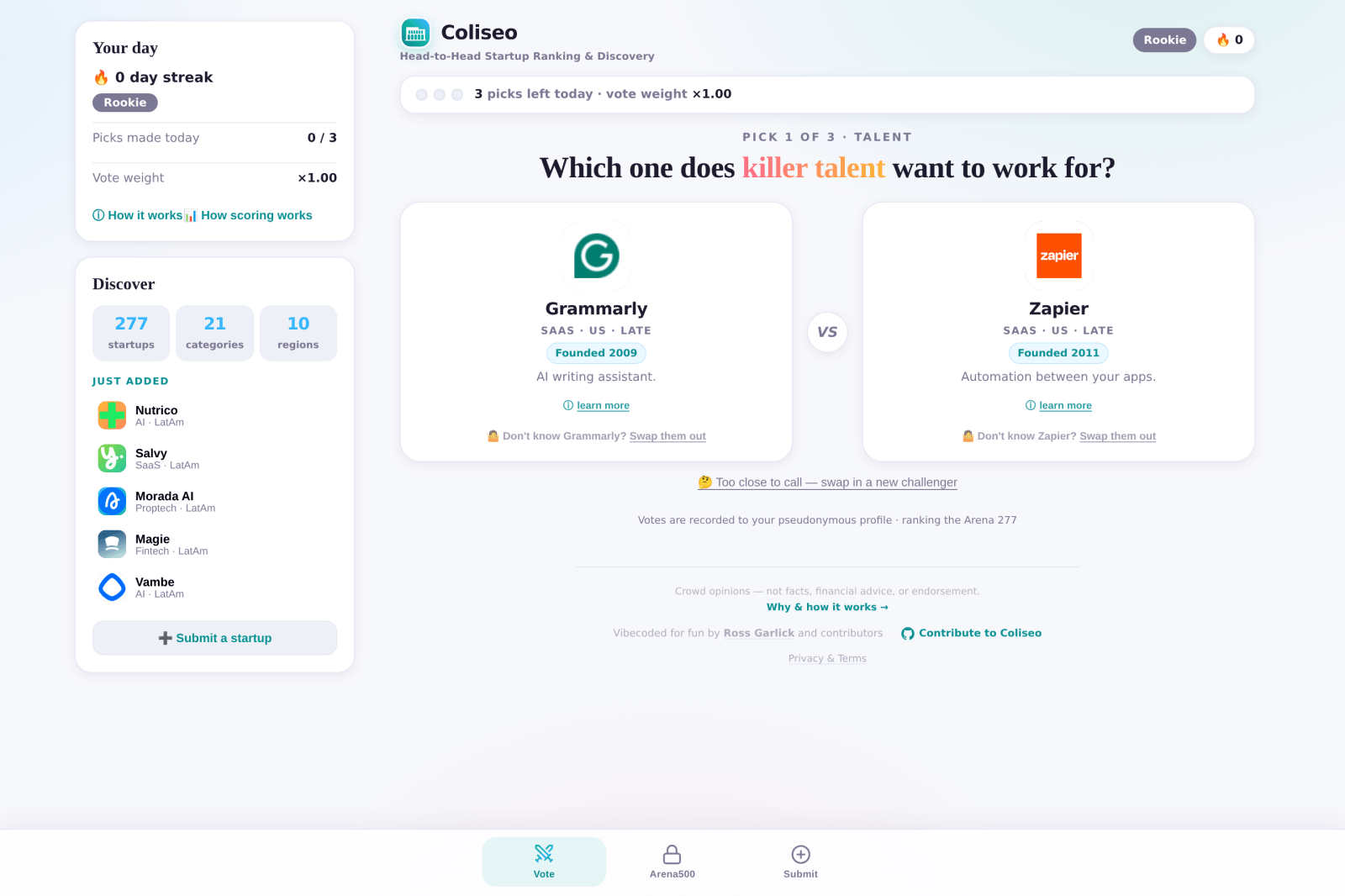
I’m writing this post without the use of AI so that I can say I did at least something myself, because wow, I just spent the past 4 days vibecoding **[Coliseo](https://www.coliseoelo.com)**, a Wordle x Fantasy Football League head-to-head daily game competition for the top startups in the world, and I really barely did anything.
Coliseo is live at coliseoelo.com. Play today’s three rounds, then come back for the build story.
I’ve wanted to push myself to vibecode for the past few months. I’ve read the accounts of how Claude Code and Codex have changed the game and now even software developers aren’t coding. It’s no longer software engineer _enhancement_ but the whole shebang.
But it’s still daunting for a non-technical person.
At least, that’s what I thought until I began.
**This blog is to document for other non-technical builders or anyone with an idea how easy it was for me to build my first true software “product” and get it live.**
### Step 1: Ideation
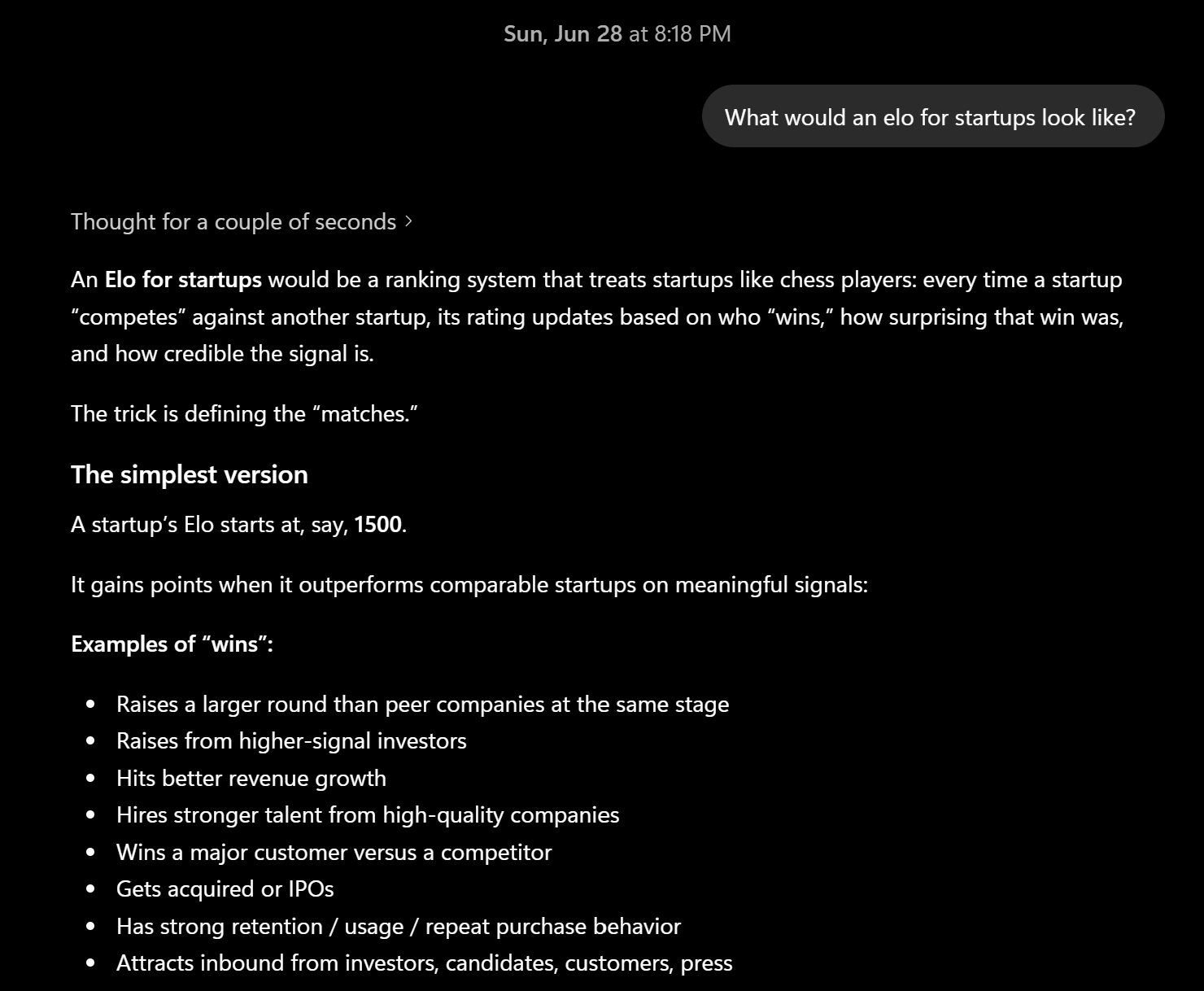
The idea for Coliseo has been kicking around in my head for a while - an open source leaderboard of private Startups that can be tracked and bet on, powered by the wisdom of the crowd. Scored with an ELO rating system, like [Chess.com](http://chess.com) or Tennis players. An index of which companies are “winning”, even though they may compete in disparate fields.
So one day a couple of weeks ago I opened ChatGPT and simply asked:
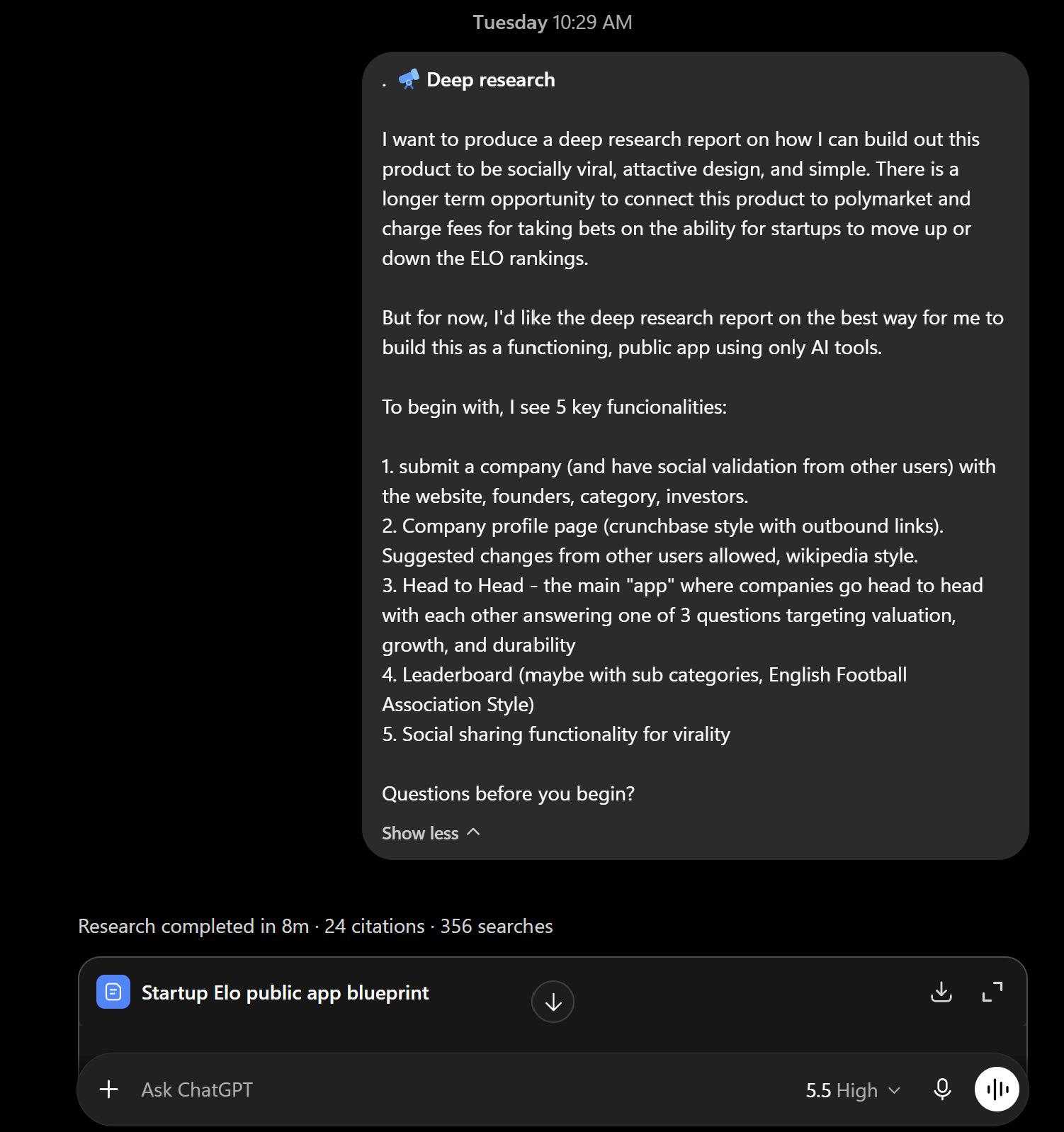
I had a back and forth and slept on the idea for 10 days, before ultimately asking GPT for a deep research report on the spec/tech stack for an ELO for Startups product:
I was relatively happy with the [output](https://www.dropbox.com/scl/fi/x6emhq0w476kh782blwn1/Startup-Elo-public-app-blueprint.pdf?rlkey=ajd94khnx37uu7yj4dqokal76&st=uoby6u8v&dl=0) which discussed the different platforms recommended to turn an idea into reality: “For the build stack, the best practical choice for an MVP is Lovable + Supabase + GitHub + Vercel/Open Graph images + OpenAI Responses API + Playwright.”.
If that sentence scared you, it did me too. But that’s why we have AI to help us!
### Step 2: Claude Cowork product iteration
I could have tried to move straight into GPT’s Codex from there, but I was still unfamiliar with it at that point, so turned to my trusty, familiar friend, Claude Cowork, to see how to proceed from there.
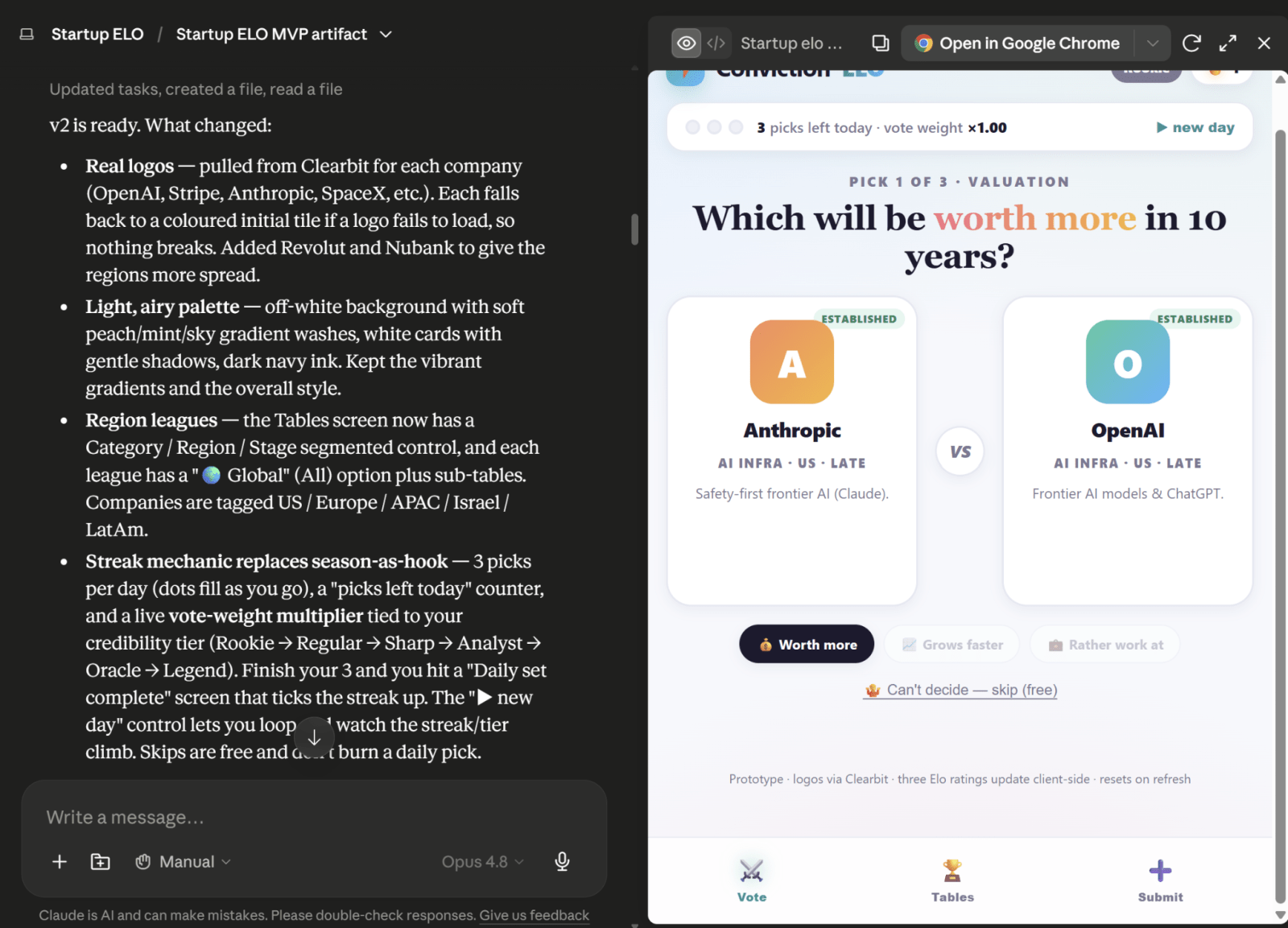
Artifacts in Claude were as close as I had gotten to date at building a software product. They live in Claude (ie. not on the web) but there is some real interactivity that feels like a superpower for a non-technical user like myself. As a person who had previously tried and failed to learn to code basic HTML and CSS, this was already a massive step up in my capabilities for turning my words into code, albeit just locally. This is a preview of the artifact that was functioning in less than 30 mins:
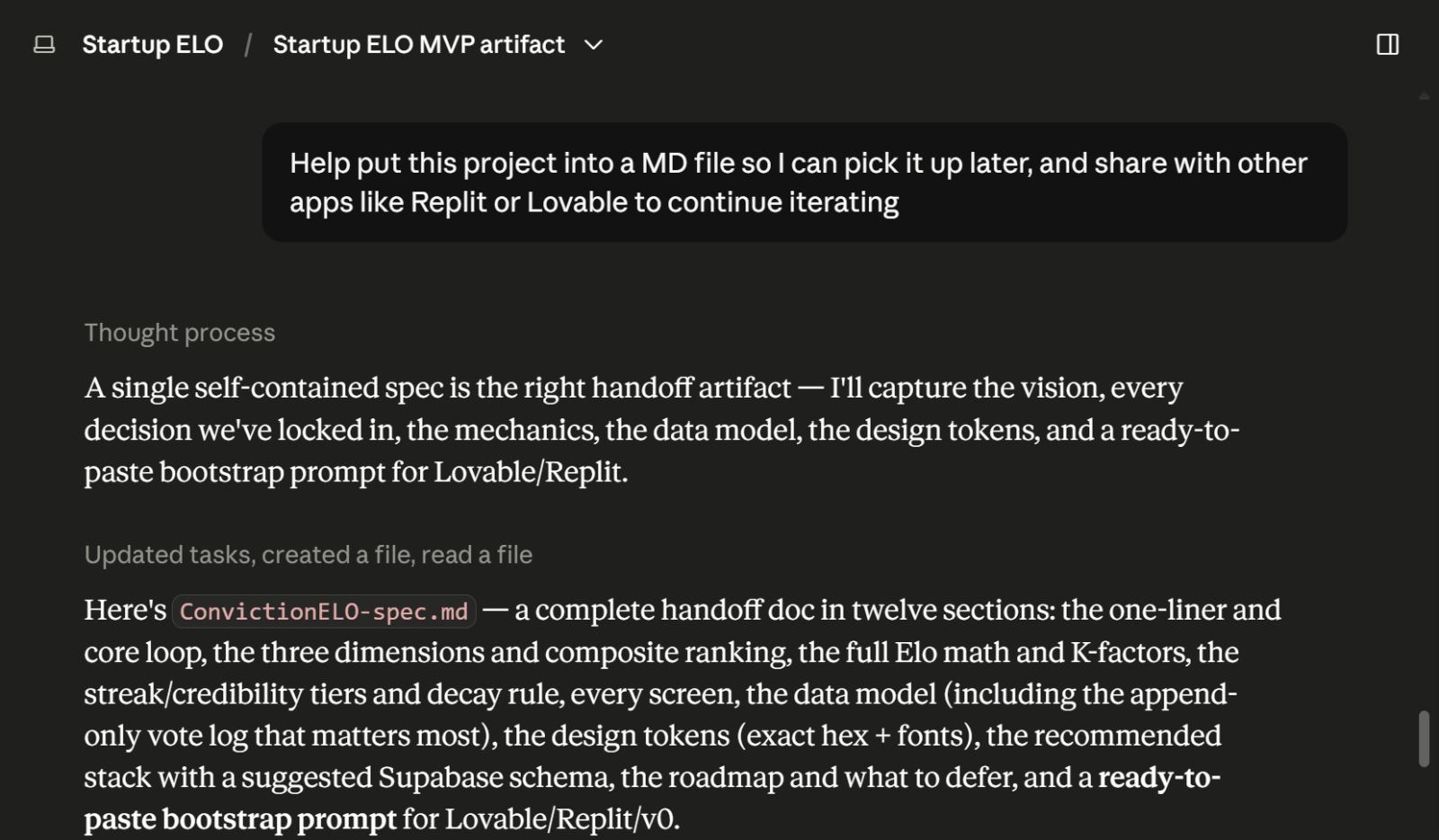
The beauty of Claude Cowork is that it could write real files on my computer, so while I was talking to it about each step, Claude would populate the folder and build out the MD files and assets that could then easily be referenced later.
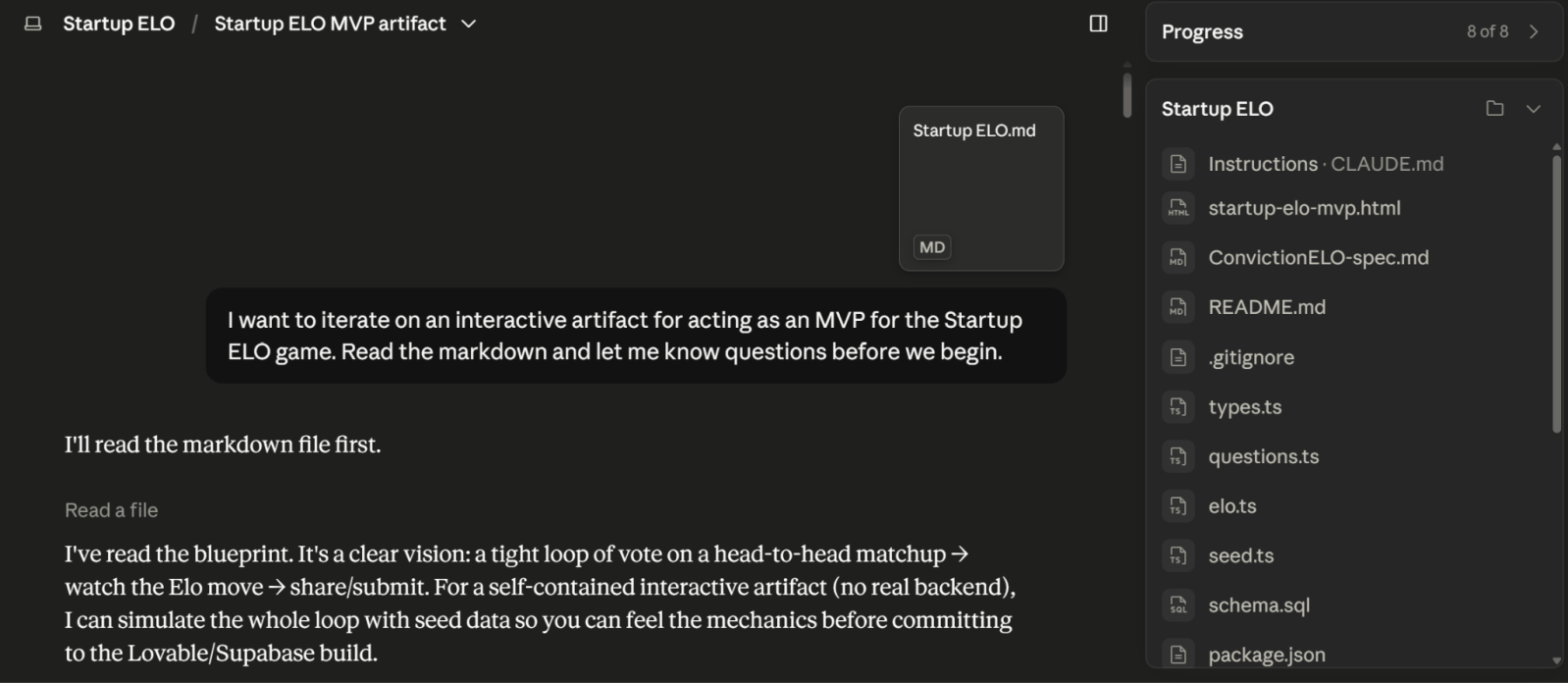
This was the prompt that started to turn Coliseo from more than a fun project to a real thing:
Now, I know _something_ about writing Software, and I knew that at some point these files would have to exist on the web, and the platform I know best for “scaffolding” a real software product is Github. I’ve previously interacted with Github but been very intimidated at what a “repo” or “pull request” actually means.
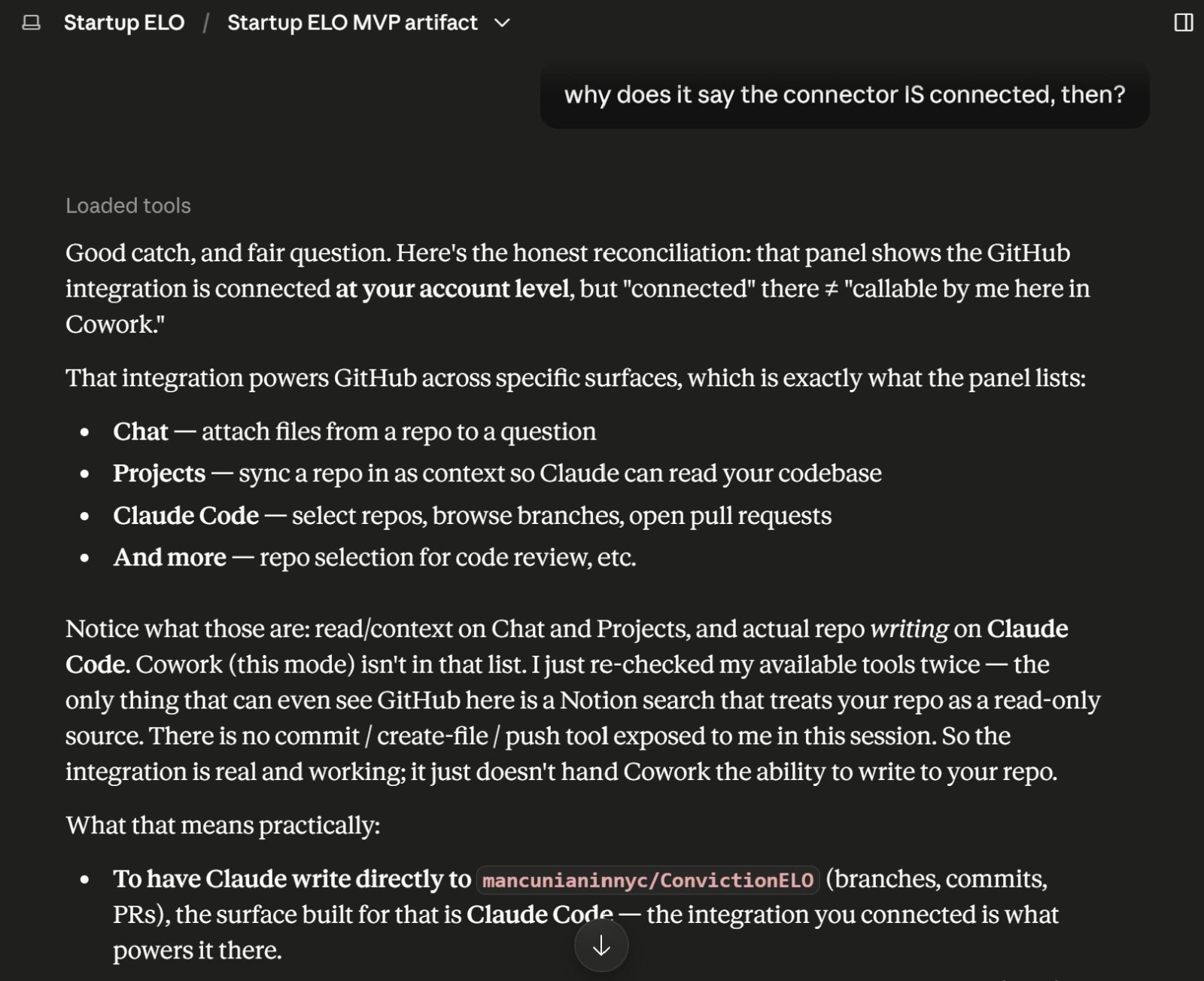
I have a free Github account and I used the “Connector” functionality in Claude to connect it, but Claude Cowork couldn’t seem to get it to work, and I began to worry that for some technical reason I wasn’t going to be able to advance any further. This could have been the stumbling block where the project died. But Claude once again came to the rescue:
So to go any further, I had to brave the daunting prospect of dealing with Claude Code, rather than Claude Cowork. I asked Cowork to get everything as organized as possible with local files and give me a prompt to get started in a new session in Claude Code…
And that’s when the magic really began.
### Step 3: Unleashing Claude Code
It took me all of 5 mins to overcome my concerns about Claude Code and feel comfortable with it. Effectively the only differences, as far as I can tell, are the context window usage limits, and the ability to run not only locally but also in the Cloud or on a remote computer (e.g. a Macmini). I also discovered (after a few hours of pressing “Allow Once”) the “Mode” functionality that allows Claude Code to take more actions autonomously, which I now have on “Auto” by default.
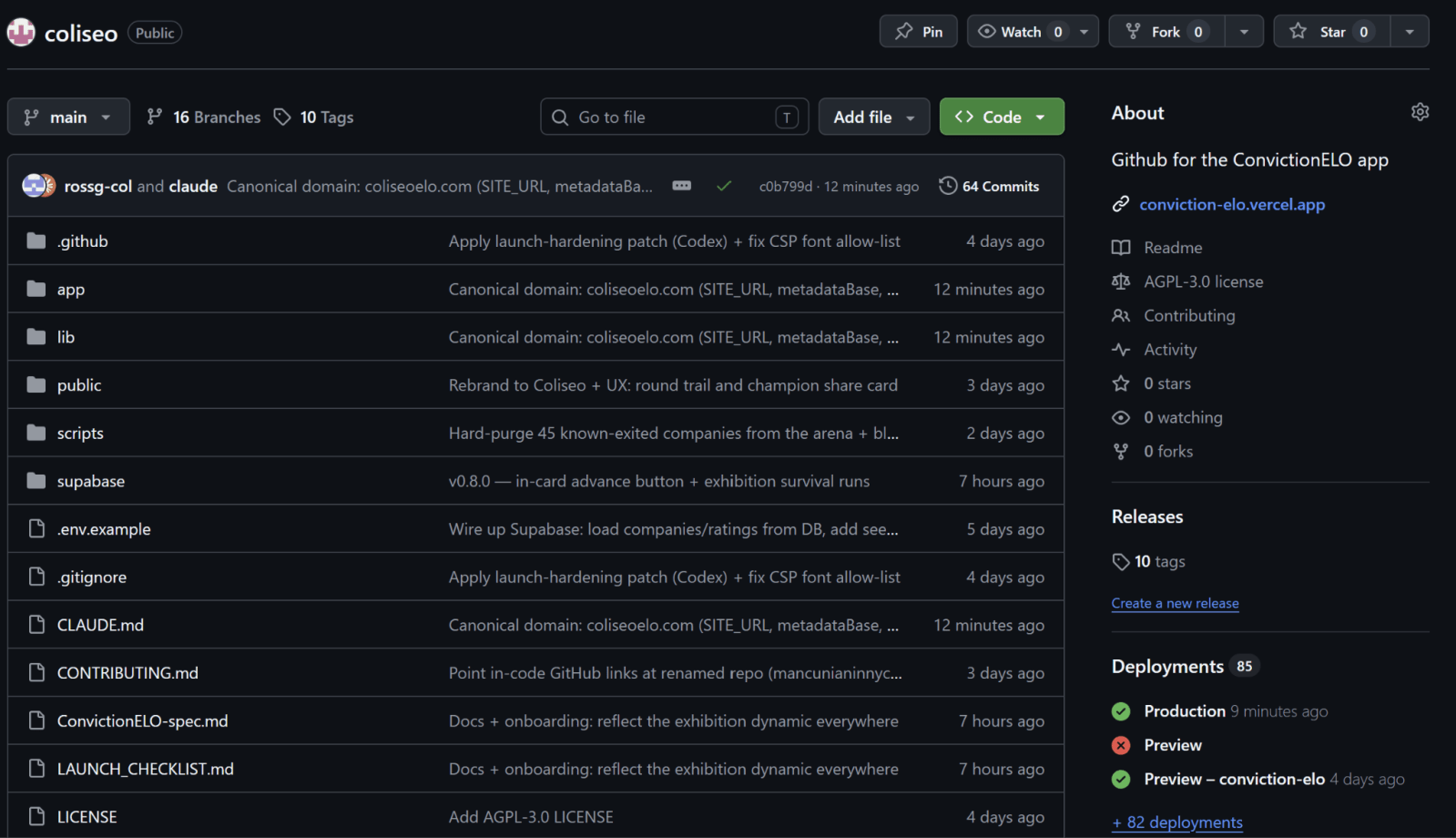
I won’t take forever explaining everything we did step by step, but I will say that over the course of 3-4 hours we went from an idea to a live product MVP, with a fleshed out repo on Github, a backend database connected on Supabase, and an App that was live and running on Vercel. All free, all set up directly with Claude Code. My mind was blown. I barely did anything, and look at my Github for this project: [https://github.com/mancunianinnyc/coliseo](https://github.com/mancunianinnyc/coliseo).
My Github repo for the project, fully built by Claude Code
No seriously, open the URL and scroll down to the Project Overview, the Roadmap, and how to contribute. I didn’t write a single word of that. It’s unreal. I had a live software project, fully vibecoded with Claude Code.
### Step 4: Product development
Between Thursday and Saturday I basically went back and forth with Claude Code iterating on the product. I built exactly what I asked for, which oftentimes isn’t the best idea. I spent lots of time thinking about where I could possibly imagine this project going, and how best to build a product that I could be proud to show anyone, from Paul Graham to my wife.
It’s an amazing thing when you can just talk to the AI and it can actually build in real time, and within 15 mins you are interacting with the idea that only just occurred to you.
It’s addictive, tbh.
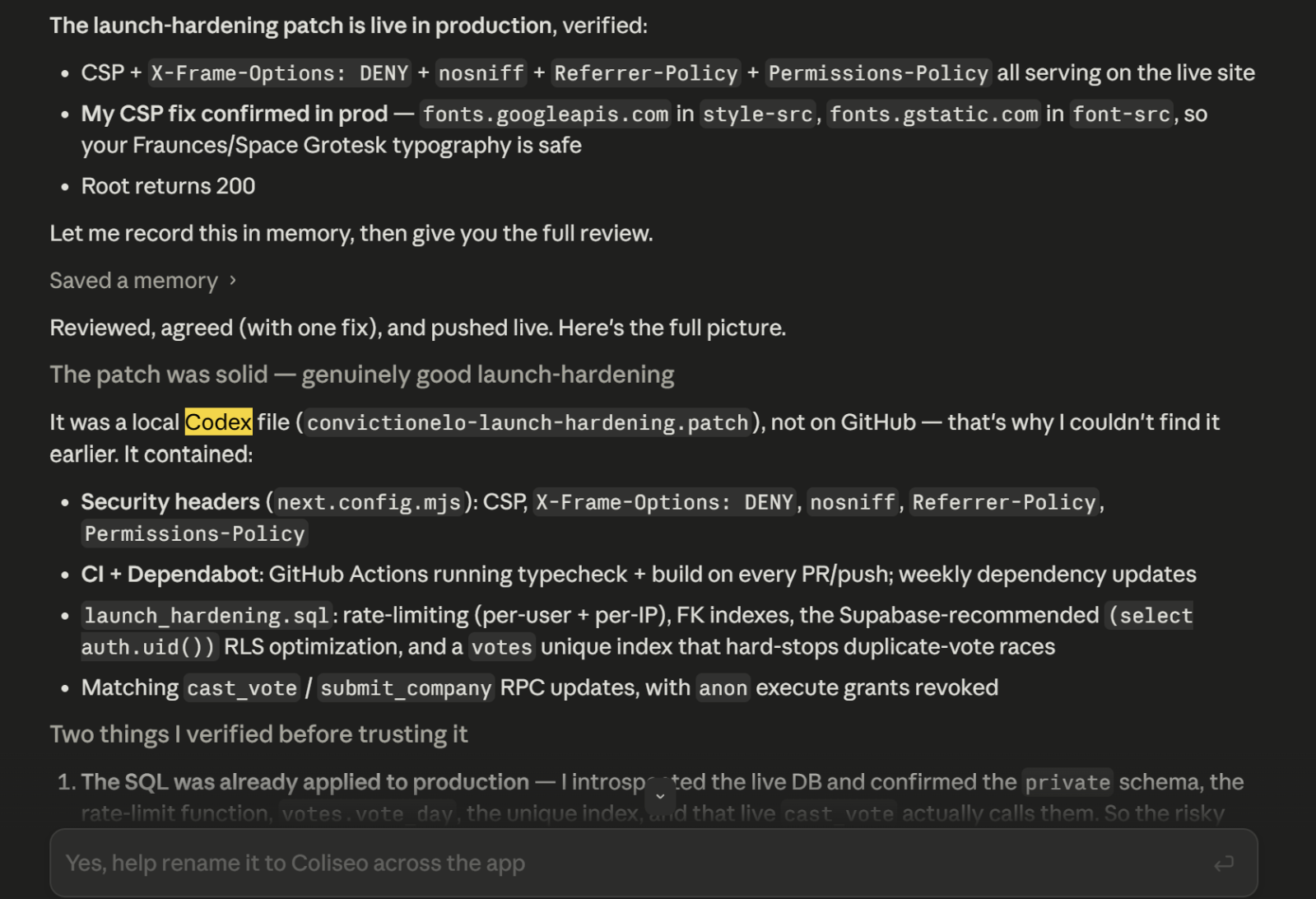
We spent time iterating on the gameplay design, then the UX, then the ways in which the results/leaderboards could be utilized. I was conscious of AI slop-build quality so I got Codex involved (sidenote: by now I wasn’t afraid to open Codex) and asked it for recommendations on improving the quality of the build and making the repo more robust for a public launch.
There’s nothing like getting your different AIs to compare and critique the work of the other.
We rebranded from ConvictionELO to Coliseo, a nod to the “in the arena” head-to-head nature of the game, and built a logo and branded the leaderboard as the “Arena500”. We built a “Discover” feature and social shareability functionality. And we fleshed out the Privacy terms and protected the backend by resetting the Supabase Database PW.
I asked the questions, Claude Code and Codex did the work:
* Moving Elo scoring to the server so users couldn’t manipulate rankings.
* Replacing the original game mechanic with king-of-the-hill roughly 25 minutes after trying it.
* Designing fame-aware matchmaking so the rankings measure conviction rather than recognition.
* Turning 831 reset queries into one bulk operation.
* Fixing the UTC-midnight issue.
* Rotating a database password after it appeared in a chat.
Finally, today I felt comfortable enough with the product that I felt the time was right to buy the domain name [www.coliseoelo.com](http://www.coliseoelo.com) on Namecheap. Obviously, Claude Code did all the hard work to guide me how to connect it to my app, and subsequently light up Google Search Console for SEO indexing and other things that I hadn’t even contemplated.
### Step 5: Launching Coliseo
This blog post is the unofficial public launch for [Coliseo](http://www.coliseoelo.com), and I hope that those of you reading will try it out and let me know what you think of the product! It’s fun! And if it isn’t fun, let me know and tell me why!
Anyone who uses it from here is a beta tester and you have my eternal thanks for reading this far and trying Coliseo for yourself, so I can incorporate your feedback before publishing it on Product Hunt or Hacker News and other broader platforms this week.
Please send me a [Whatsapp](https://api.whatsapp.com/send/?phone=573054329547&text&type=phone_number&app_absent=0) if you want to be involved in promoting Coliseo when we launch later this week. I appreciate you all!!